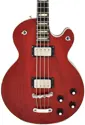
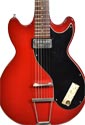
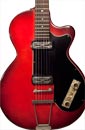
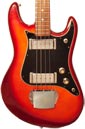
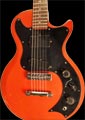
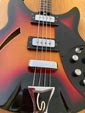
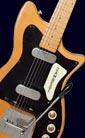
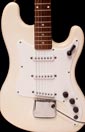
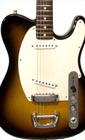
The Vox Bassmaster (V204) was one of Vox's earliest guitars, and (along with the Contour bass) their first bass. It was initially advertised in December 1960 (check out the first advertisement announcing JMI's new line of Vox guitars. But British guitar manufacture was in its infancy, and unlike Vox amps, the first guitars were primarily aimed at entry to mid level guitarists - perhaps fans of the Shadows, one of the earliest British guitar bands who endorsed Vox amps, yet played Fender guitars.
The Bassmaster was short scale (30") and the thin neck made it ideal for younger hands. The Bassmaster was a loose Fender Precision copy, but smaller, and more economically manufactured. It had similar hardware and headstock, but with a smaller offset body and much narrower neck. JMI offered the Bassmaster from late 1960 until at least early 1966.
The Vox Bassmaster was built in the UK, originally by furniture manufacturer Stuart Darkins, later by JMI with necks outsourced to furniture manufacturer G-plan. Electronics and assembly took place at the JMI plant in Dartford.
Have a look at some of the Bassmasters below, and click through for more details of each bass.
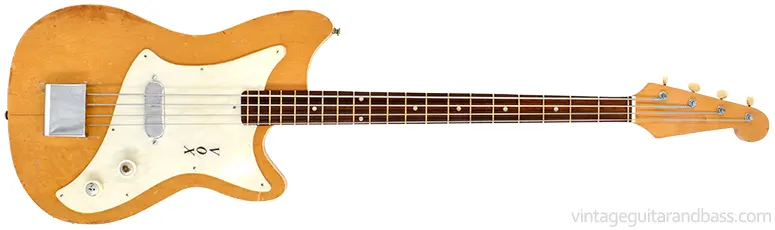
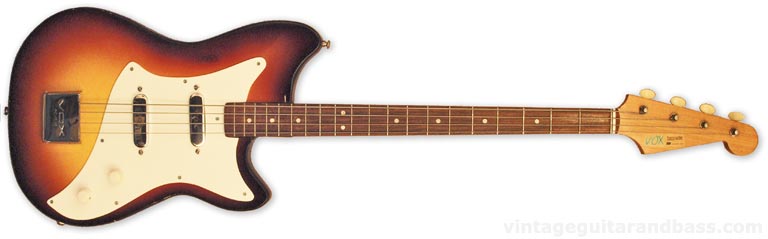
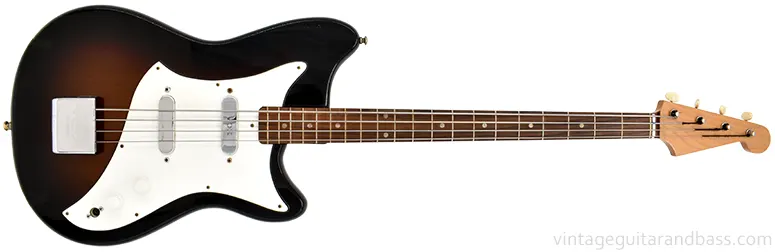
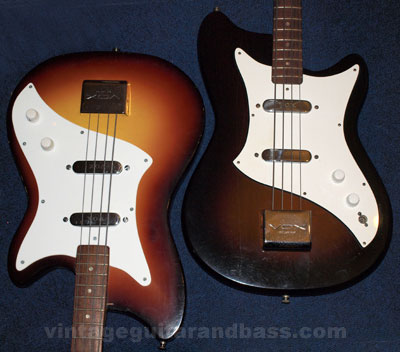
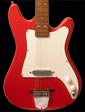
Two British-built Vox Bassmaster basses, a 1963 (left) and a 1965 (right). These are less common colours; most are red.
Similar Models
A closer look
Vox Bassmaster construction
The earliest Bassmasters were constructed with a solid wood slab body with thin maple veneer front and back, and binding on the front. The neck is sycamore (a European tree closely related to maple) with a rosewood fingerboard.
Slightly later versions were made with plywood bodies. At this point the edges were given a slight curve, and the binding discontinued (see this 1963 Vox Bassmaster). They also used mahogany as a body wood (see this 1965 Vox Bassmaster) and sycamore as body material. Necks were thin: just 1 5/16" and without an adjustable truss rod. Vox catalogues only mention red and white polyester finish options, although various burst finishes were available, and perhaps black. But red was by far the most common colour.
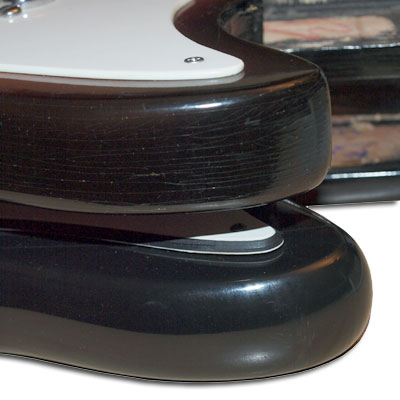
Naturally, the solid wood bodies are more desirable, and it is easy to see this if you examine the unpainted neck pocket. But even without taking the neck off you can often tell by looking at the curvature of the body edges - in the picture here the top guitar has a laminate body, the bottom is solid mahogany - notice the difference in shape. Click the image to see a larger version.
The earliest Bassmasters had a one 'wide' single coil pickup, later changing to two Vox single coil pickups. The circuitry is very simple (wiring diagram): just one volume and one tone control. The input was a coaxial tv aerial jack, positioned on the side of the bass until the second half of 1964, then mounted on the scratchplate from then on.
But sales were good and today, the Vox Bassmaster (along with the Clubman) is probably the most regularly seen of all vintage Vox basses in the UK, though maybe not so common elsewhere in the world. They don't sound bad either - have a listen to the Vox Bassmaster soundclips - a 1965 mahogany-bodied Bassmaster, through an Ampeg B15. I like the last clip with the tone rolled down.
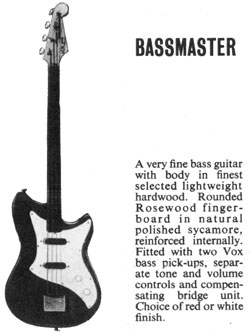
The Vox Bassmaster bass, as shown and described in the 1963 Vox catalogue
A British Vox bass
All Bassmasters were British-built, and when guitar production in the UK was superseded by the Italian-built Vox's, the basic body shape and thin neck lived on as the Vox Panther and Vox Hawk bass guitars.
When JMI folded, and Vox guitar production ceased in early 1968, leftover Bassmaster stock was sold on by Dallas Arbiter nominally unbranded (though potentially still with a Vox engraved bridge cover and pickups) simply as model 4533. This was at a somewhat reduced price of £21 1 8 (the 1967 list price was £28 15 0).