

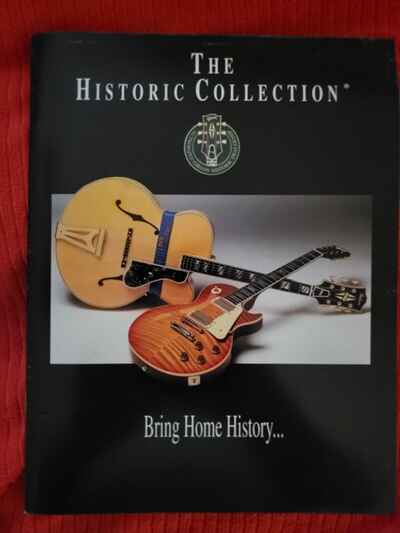
Guitar companies have pretty much always printed catalogues, and aspiring guitarists have always pored over the different models, usually way out of their reach... Perhaps one day... But they can also be very useful when researching a vintage instrument today. The original catalogues, price lists, brochures, owner's manuals, and other promotional material can be really useful in establishing dates, but also giving general information on how the manufacturer intended it to be used. Vintage guitar catalogues are getting almost as collectable as the guitars they feature, and when included as 'case candy' can certainly increase the desirability of a vintage guitar.
Unfortunately the originals can be very hard to track down; some are quite commonly listed on auction sites like eBay, but in a lot of cases, few were ever printed, and the vast majority were simply discarded. Some of the rarer brochures and leaflets can sell for high prices; usually tens, but often several hundred pounds/euros/dollars.
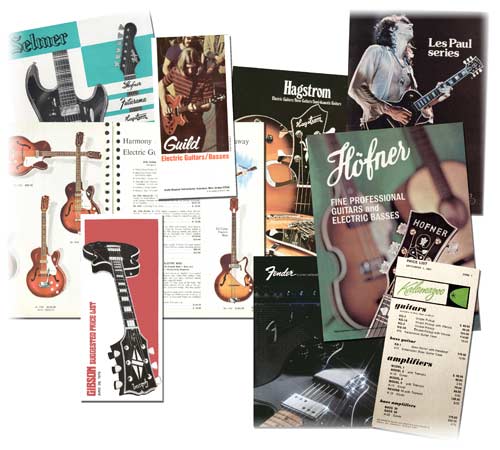
A number of old and rare catalogues are included on this site in order to aid guitar identification. Most contain a guitars intended specifications, but these original documents very regularly contained exceptions and errors - this information has to be treated with caution! It was commonplace not to update images and / or text from previous catalogue editions, particularly for models with long production runs - maybe to save money, maybe as an oversight, or maybe it was just not seen as being particularly important.
The catalogue scans on this site are sorted by manufacturer: follow the links to find vintage guitar catalogues, brochures and owner's manuals, primarily 1950s-1970s.
Guitars sold worldwide tended to have an overseas agent looking after the distribution and advertising in that particular territory. For example, in the early 1960s, Selmer were the UK distributor for numerous non-UK brands: Hofner from Germany, Hagstrom from Sweden, and Gibson from the US. UK brand Vox were distributed by the Thomas organ company in the US, whilst Vox's parent company JMI distributed Fender in the UK. So British catalogue listings for Gibson and Hofner, for example, appeared in Selmer catalogues.
Other examples include Merson, and later Ampeg, distributing Hagstrom, and Sorkin distributing Hofner in the USA. In the UK Boosey and Hawkes distributed Guild and Arbiter distributed Gretsch.
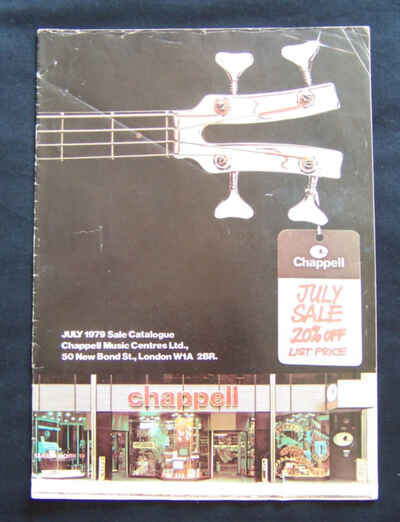
Catalogues were typically available from guitar dealers and by mail from the manufacturers themselves (or the distributors in overseas territories). What's more, some larger music stores produced their own catalogues. Often these contained pages from the manufactures own catalogues, but sometimes they were entirely separate. Examples include LD Heater in the US, and Bell music in the UK.
Some of the bigger manufacturers (most notably Fender in the early 1960s) started including somewhat slimmed down catalogues in the centre pages of popular music magazines such as Downbeat. Later Gretsch, Gibson and other companies followed suit. Early catalogues were naturally black and white, with the occasional two-colour font or page design. Some of the first full colour guitar publicity was produced by Gretsch in the 1950s. Though by the mid-1960s guitar sales were at a peak, and most manufacturers were using colour, often producing lushly designed full-line catalogues containing all guitars, basses, amplifiers, banjos etc produced by the company at that time.
Since the 1970s, colour printing has been the norm. All but the smallest companies print catalogues in significantly larger quantities than in the previous decades.
See also - Vintage guitar advertising

$30


$50
$50

$50

$99

$159

$195

$3790
$4890

$6490

$21900

$81900
$98000

£27
£27
£27
£27

€29
Follow


