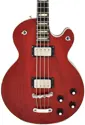
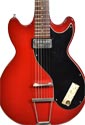
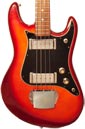
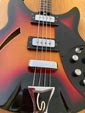
The Vox Clubman bass was a short scale (30"), two-pickup bass, produced in the UK by JMI, primarily for the UK market. It was Vox's least expensive bass model, and sold pretty well to student bassists in the mid 1960s.

It isn't a bad bass, though nothing fancy. The fretboard is flat, unlike the radiused boards of other Vox bass guitars, but it has a comfortable, playable G-plan neck. The board in this example is actually solid sycamore dyed to appear like rosewood. Some earlier examples had a rosewood veneered sycamore board.

Dating this instrument is not difficult; the neck heel is stamped with the date Feb 1965. Furthermore, it has a number of later Clubman features, such as the thicker white escutcheon (scratchplate) with wide black revealed edge, and front mounted output jack. Earlier models had a plain black, plain white, or thinner three-ply (w-b-w) plate, and a side-mounted co-axial output.
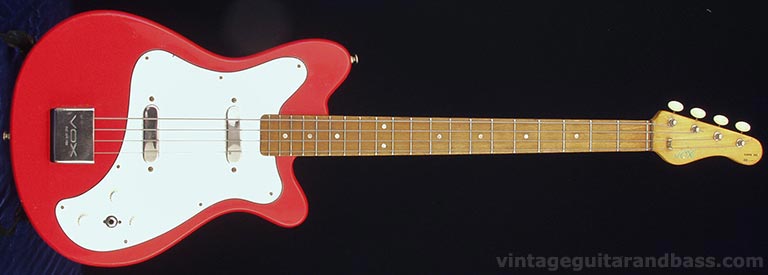
1965 Vox Clubman bass - front view
1965 Vox Clubman bass - reverse view
Model: 1965 Vox Clubman Bass
Body: Mahogany
Neck: One-piece sycamore with non adjustable truss-rod. One-piece dyed sycamore fingerboard with dot inlays
Scale: 30"
Width at nut: 1 5/8"
Weight: 2.58kg
Hardware: Two British Vox single-coil pickups, pressed metal bridge and open gear tuning keys. Single tone and two volume controls with white plastic control knobs

The Clubman bass had a May 1965 UK price of £23 2s - compared to £28 7s for the Bassmaster, £89 5s for the Phantom bass and £94 10s for the Symphonic. As these prices suggest, the Clubman and Bassmaster were not of the standard of the Symphonic or Phantom. Although the Bassmaster was slightly more expensive than the Clubman, the latter had a wider neck and was more playable as a result (the Clubman bass had a 1 5/8" width at nut, compared to 1 5/16" for the Bassmaster).

This is a lightweight instrument, at 2.58kg slightly lighter than the Bassmaster (around 3kg) and significantly less than the Symphonic bass (around 4kg).

1965 Vox Clubman bass - body detail
One feature that shows this to be a later period Clubman is the thicker scratchplate with black revealed edge, used from early 1964. For 1962 and most of 1963, the Clubman had a thinner black bakelite scratchplate - compare with a 1963 Clubman bass here.
1965 Vox Clubman bass - reverse body detail
The bolt-on neck is attached via four screws. The neck plate size and precise location varied over the years; this is the latest, larger version.
1965 Vox Clubman bass - pickup detail
The Clubman bass was equipped with two Vox chrome covered single coil pickups, part 09-101-0. These Vox pickup casings were often marked with the same Vox logo as on the bridge cover, though not in this instance. The pickups themselves were a fairly simple single-coil design. These are exactly the same pickups as fitted to very many guitar models of the same period; certainly the most widely-used JMI Vox pickup.
1965 Vox Clubman bass - control detail
Unlike the (very similar) Vox Bassmaster, the Clubman has a volume control for each pickup, and one master tone. These white plastic control knobs were fitted to very many UK-produced Vox guitars and basses circa 1962-67. Early Clubman basses and guitars (in fact most of Vox's less expensive models) were fitted with a co-axial output jack, though towards the end of production a regular jack was used on some models, including the Clubman bass. Vox did, however, continue using scratchplates drilled for the coaxial outputs, leaving unused holes, either side of the jack. These were often covered with a white circle of scratchplate plastic.
1965 Vox Clubman bass - Vox headstock logo
1965 Vox Clubman bass - headstock detail: JMI Dartford Kt

Typical to early British made Vox's, this bass has the Green Vox logo. The model name and 'JMI Dartford Kt' are on a separate decal - earlier examples had these details combined on one decal. JMI = Jennings Musical Industries, Kt refers to the county of Kent, UK. These decals are never particularly hard wearing, and damaged/incomplete decals are commonplace.

Machine heads are individual open-gear type, with plastic buttons, part number 09-301-0.

1965 Vox Clubman bass - tuning key detail
Tuning keys are individual open gear type, with plastic buttons
1965 Vox Clubman bass - serial number
The five digit serial number is stamped into the reverse of the headstock, just below the tuning keys

The Clubman bass had a one-piece sycamore neck made by a British furniture manufacturer, G-plan, with no adjustable truss rod. The guitars were then assembled in Vox's Dartford plant. Simple open-gear tuning keys like these were used widely by Vox in the early days. Another early feature, only seen in the early British Vox's, is the serial number stamped on the reverse of the headstock (just below the 'E' tuning key); this was the standard location for all UK-produced (JMI) Vox guitars up until early 1966, and on a few models, including the Clubman bass, a little beyond.


1965 Vox Clubman bass - compensating bridge detail
The compensating bridge is a straightforward stamped metal design, with a cover featuring the Vox logo (parts 09-303-0 and 09-304-0 respectively). The bridge is simple but effective, rather like that of an early Fender Precision. It was used widely on low-end solid body Vox basses, including the Bassmaster, (but not on the Symphonic or Phantom models) throughout the period of their production. Effective if a little lightweight.
1965 Vox Clubman bass - heel detail
With the neck removed from the body, the date (Feb 1965) and G (for G-plan, the neck manufacturer) stamps are visible. Codes on the neck base, and within the neck pocket of the body are the simplest way of dating JMI period Vox guitars.
1965 Vox Clubman bass - body routes

The body itself is simple enough - note the rich brown wood (mahogany) of the neck pocket. Earlier examples had a thinner laminate wood body - compare this bass with a 1963 Clubman bass.

Vox Clubman Bass sound clips

The Clubman is a great sounding bass, and despite simple controls (two volumes, and a master tone) it can get a variety of nice tones.

Recorded through a 1964 Ampeg B15N (volume 5/10, treble 5/10, bass 5/10) mic'd with a Shure SM57, into a M-audio mobile pre USB interface.
1965 Vox Clubman bass
1964 Ampeg B-15N
Both pickups, all controls 10/10. Fingerstyle.
Both pickups, all controls 10/10. Played with a pick
Both pickups, volume 10/10, tone 5, played with a pick
Neck pickup only, tone 0/10. Fingerstyle
Bridge pickup, volume 10/10 and tone 3/10. Fingerstyle
Got an opinion on the contents of this page? Disagree with something written above? Please comment