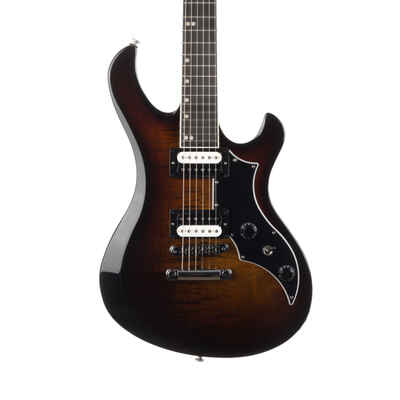
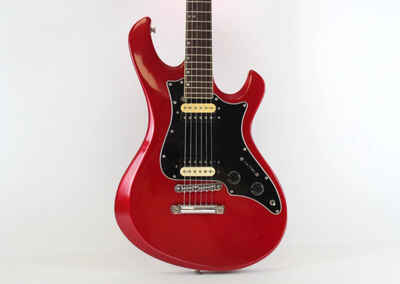
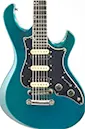
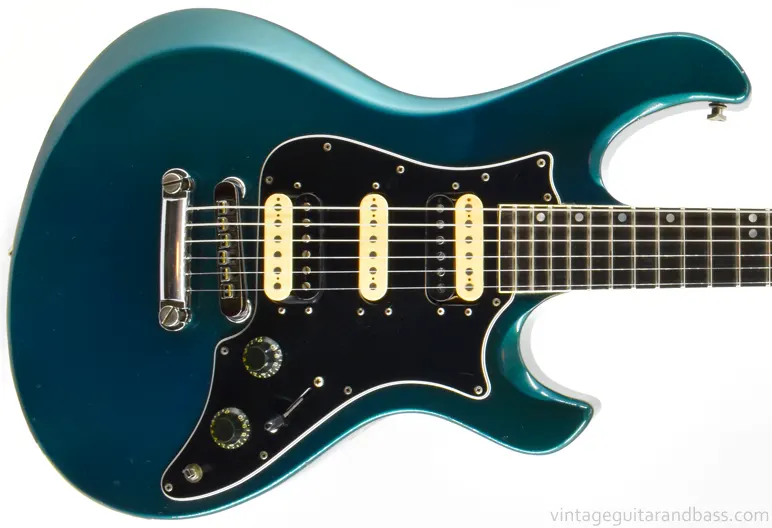
The Gibson Victory MVX (sometimes MV10) was designed to have a lot of different sounds. MV stood for "multi-voice", with X the Roman numeral for 10. This referred to the "ten distinct sounds from one great new guitar", achieved with a five way Stratocaster-style blade pickup selector switch, combined with a separate coil tap switch "for single coil/humbucking tonalities". And it's a great looking guitar! This example, in Twilight blue was produced at the Gibson Kalamazoo plant, stamped on 20th Nov 1981, and would have been priced at $929 (1/1/1982 price list). At this time, the MV-II was listed at $799, the Les Paul Deluxe $899, and the Les Paul Standard $999.
The Victory series was created by the Gibson research and development team in Kalamazoo: Bruce Bolen, Chuck Burge, and Tim Shaw. Production of the Victory basses began at the second Gibson plant in Nashville. But the Victory MV guitars were initially made at Kalamazoo, and this continued until late 1981 when production also moved to Nashville. But there was a period (October / November 1981) in which both plants were producing Victory guitars - at least according to decoded serial numbers. Whether any parts (including stamped necks?) were moved from Kalamazoo to Nashville is unclear.
So this is one of the final Kalamazoo-built Gibson Victorys, with later examples shipping from the Gibson Nashville plant.
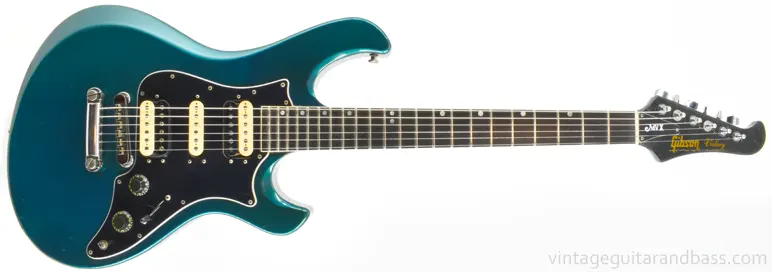
The Victory series was very much aimed at Fender players - offering them an instrument that felt like a Fender, with the same intuitive controls, but with an expanded tonal palette. As described in the "no substitute for Victory" flyer the series has "voices as thin and sparkling as they are fat and rich". The Victory MVX can be described as a super-Strat, with a similar body style, the same five-way pickup selector / controls in the same position - but with the addition of a set neck and humbucking mode for some more traditional Gibson tones. The original 1981 advertising pictured Strats, Les Pauls, and a G&L F100, claiming Sounds Like... All Of 'Em.
But the construction was very much Gibson. The Eastern hard rock maple neck set into a hard rock maple body made for a heavy guitar - the same construction as the late seventies Gibson RD series. Tough and durable, but certainly heavy. This one weighs 4.32kg - similar to a Les Paul. And although the body shape and controls are closer to a Stratocaster than your average Gibson, the Firebird-style headstock, and traditional post mounted bridge and tailpiece keep the Victory series grounded in Gibson tradition.
The MV-X was initially available in three finishes: Vintage Cherry Burst, Candy Apple Red and, as seen her Twilight Blue. Like Pelham Blue, this has a metallic 'sparkle' undercoat, and like Pelham Blue, this finish has a tendency to turn green as the clearcoat yellows.
A closer look at the Gibson Victory MVX
The Gibson Victory series featured some innovative new hardware. The new "top adjust" Tune-O-Matic bridge was fitted to several Gibson guitar models at the time; however the various pickup designs were exclusive to the Victory. All five pickups across the range (three in the MVX, two in the MVII) are different, and specifically designed for the role assigned.
The top adjust bridge had an angled profile, "to allow full clearance of the strings to the stop bar tailpiece, so the player can lower the tailpiece all the way to the wood". As explained in the Victory MV owners manual, raising and lowering the tailpiece directly affects response, sustain, and the firmness of action.
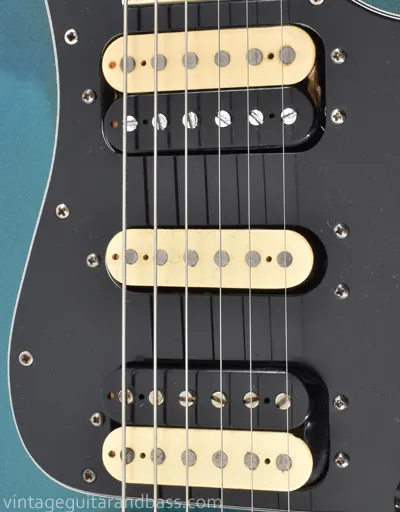
The Victory MV-X is equipped with three especially designed humbuckers, used in no other model. From top to bottom: Magna Plus (neck), Super Stack (middle), and Magna Plus B (bridge).
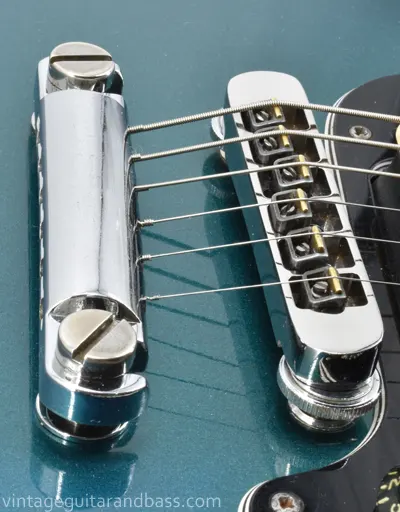
The Gibson "top adjust" Tune-O-Matic bridge and TPBR-80 stop tailpiece. One advantage of the "top adjust" bridge was that the saddle inserts were interchangeable, available in both plastic (Delrin) or, as seen here brass.
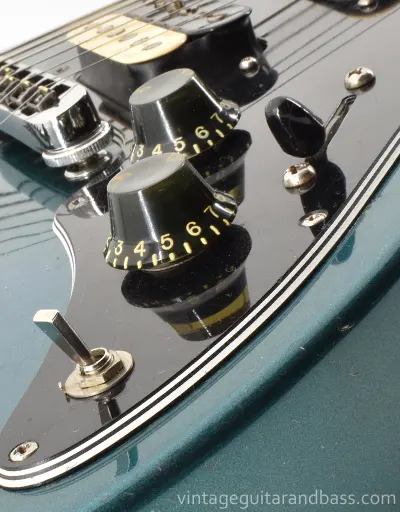
The simplicity of the controls of the Victory MV-X made a great contrast to all those 1970s Gibson solid bodies with numerous switches and dials. A simple strat-style five-way pickup selector, master volume and tone (0-10 "top hat" control knobs), and a two-way coil tap switch.
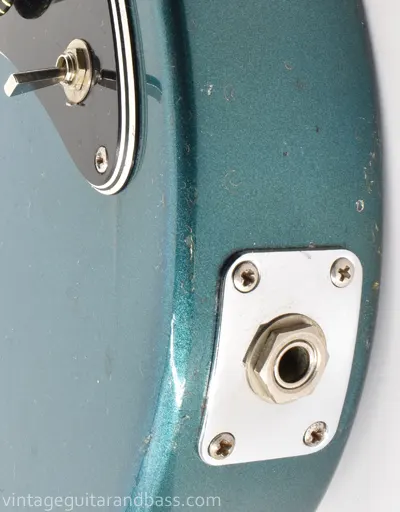
Output jack on body edge. This image shows the metallic paint of this guitar. Note the silver coat beneath the Twilight Blue.
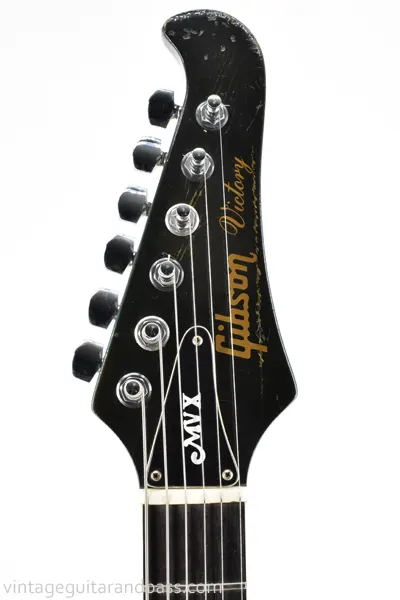
Firebird-style Gibson Victory headstock, with silk-screened Gibson logo and scripted Victory designation. Bound Madagascan ebony fretboard. Although approximately Firebird-shaped, the Victory headstock is more sloped along the top edge, to allow a more traditional tuning key placement, whilst keeping the strings totally straight along the neck and headstock. The truss rod cover is neither traditionally Firebird shaped, nor not bell-shaped, but an irregularly curved triangle, with MVX in white.
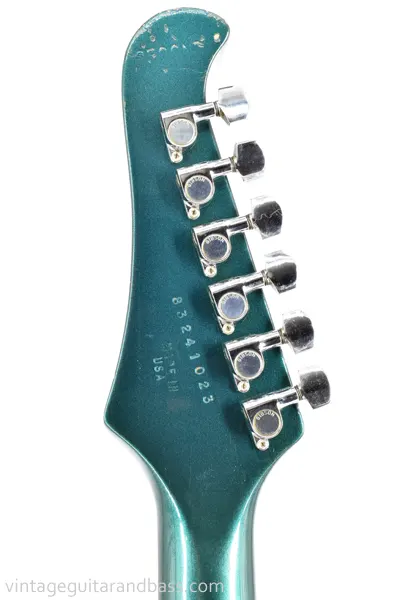
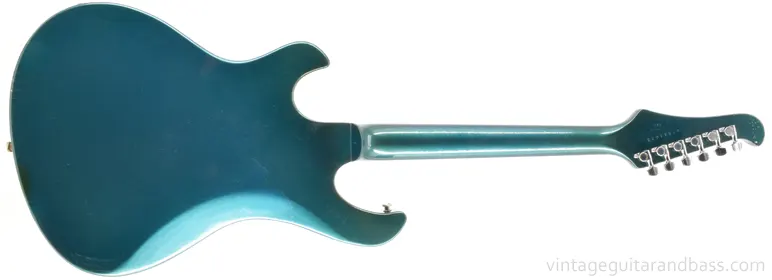
Reverse view of the Gibson Victory headstock, showing Schaller M6 tuning keys, serial number, made in USA stamp, and SECOND. Note the lack of volute on Victory MV series guitars.
The serial number 83241023 tells us that this guitar was stamped on November 20th, 1981 (day 324), and was the 23rd instrument stamped that day at Gibson's Kalamazoo plant.
As can be seen above, this guitar is marked as a second. This was typically a guitar with a small finish flaw or other non-critical defect that allowed the instrument to be sold at a slightly reduced price. With a typical vintage guitar, finding such a flaw after decades of use can be difficult, however this example has one or two probable indicators - for a full account and detailed images, see this guitar in the vintageguitarandbass members area.
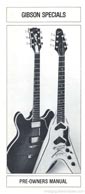
The following description comes from the 1981 Gibson Victory MV pre-owners manual.
“ The Victory MV 10 produces a myriad of separate and distinct electric guitar tonalities; those voices that fill all the needs and requirements of the dedicated guitarist, and some that you have never heard before! ”
The Victory MV2 and MVX shared the same body/neck; both are routed for three pickups, although obviously just two are fitted to the MV2. The routed area is painted matt black after the main blue finish was applied. One difference between the two models is the fretboard material - Madagascan Ebony for the MVX and Indian rosewood for the MV2.
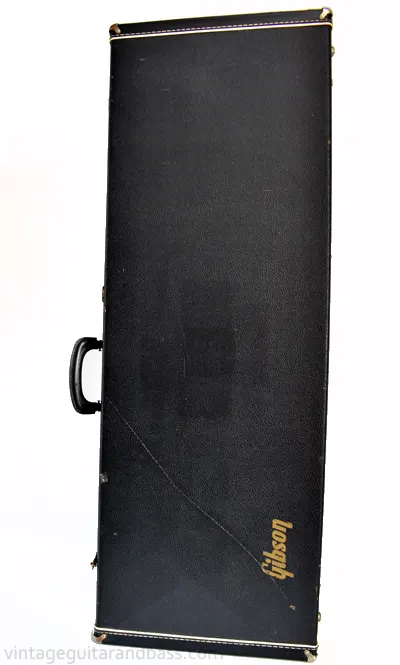
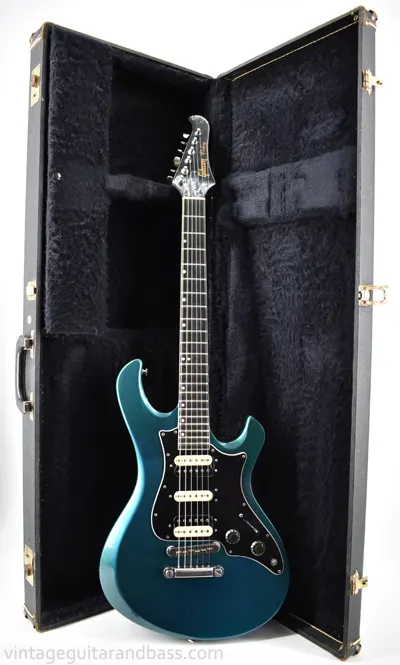
Both the Gibson Victory MVII and Victory MVX shipped in the same black-lined three-latch Gibson hard case, number 8170. Note the Gibson logo and white piping at case ends.
1981 Gibson Victory MVX 'supporting members' content
Extra content on this guitar is included in our Supporting Members area here.
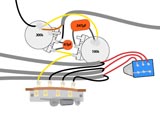
- 62 extra images (with description): large detailed images including body routes, circuitry, components, along with description and key measurements
- Pickguard tracing (PDF for accurate printing)