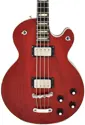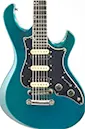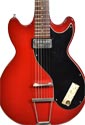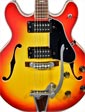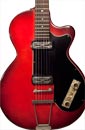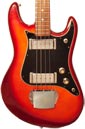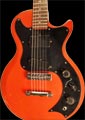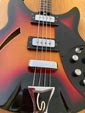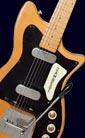
Vox Contour bass
Vox Clubman bass V202
1963 Vox Clubman (left handed)
1965 Vox Clubman
Vox Bassmaster bass V204
1960 Vox Bassmaster
1963 Vox Bassmaster
1965 Vox Bassmaster
Circuit diagram
Parts list
Soundclips
Vox Symphonic bass V207
1963 Vox Symphonic
1966 Vox Symphonic
Vox Phantom IV bass V210
Vox Cougar bass V214
Vox Escort bass V216
Vox Phantom Mk III / Mark IV bass V224
Vox Violin bass (solid body) V232
Vox Panther bass V236
Vox Wyman bass V248
Vox Violin bass (hollow body) V250
Vox Hawk IV bass V263
Vox Delta IV bass V264
Vox Apollo IV bass V271
Vox Sidewinder IV bass V272
Vox Astro IV bass V273
Vox Constellation IV bass V274
Vox Saturn IV bass V281
Vox Skybolt IV bass V282
Vox Spyder IV bass V283
Vox Stinger IV bass V284
Vox V.G.4 bass
JMI Vox bass guitars
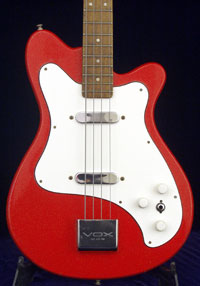
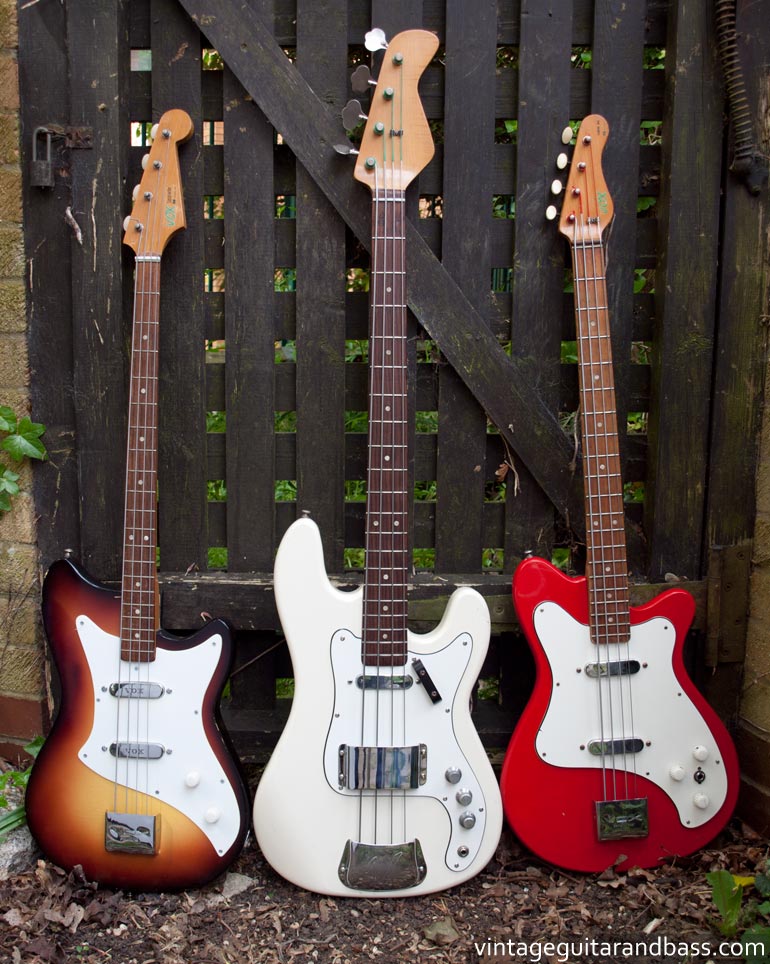
Vox produced bass guitars throughout the 1960s, made in several factories for different markets. Initially solid-body guitars were produced in the United Kingdom by Vox parent company JMI, certainly as early as 1961, and perhaps earlier. The Bassmaster and Contour bass were advertised as early as December 1960.
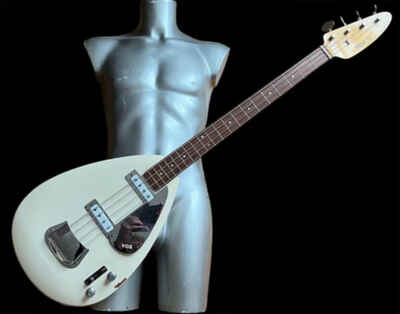
JMI were the UK distributor for Fender at the time and when the new Phantom IV was launched in late 1961 it was priced approximately the same as the Fender Precision. Simple models like the Clubman and the somewhat superior, and heavily Precision-influenced Symphonic bass, were added to the line fairly soon afterwards. These were followed themselves by the teardrop-shaped Mark IV popularised by Bill Wyman of the Rolling Stones. The entry level models were small and light with no adjustable truss rods and often made from plywood; certainly no comparison to the Fender basses available. But the long scale Symphonic and Phantom basses were actually pretty respectable. Most JMI Vox basses had single coil Vox V1 pickups, though later examples had the white plastic covered V2 with exposed polepieces.
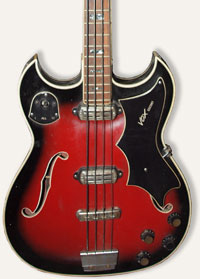
Hollow body Vox basses
Vox were more of an electronics company than guitar builders: their amplifiers were better known than their simple guitars, and they were unable to build more complicated instruments, hollow bodies etc, at least in any volume, at their Dartford, UK factory. But with the rise in popularity of semi-acoustic models in the early 1960s, Vox contracted out some guitar and bass building to an Italian maker Crucianelli, who produced the Cougar and Escort basses with Vox branding, alongside a couple similar six string guitar models, the Challenger and Lynx.
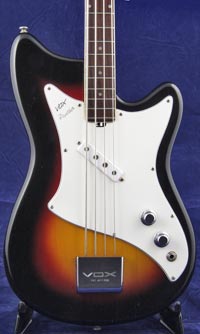
Keeping up with demand
By the mid 1960s Vox were massive, and the combined efforts of JMI and Crucianelli were unable to keep up with demand, especially from the USA, where the Thomas organ company were acting as distributors. With the additional help of Eko, a new production plant was set up; the E.M.E. factory in Recanati, Italy, producing well-built Vox guitars for import into the United States, whilst JMI concentrated on the UK and European markets. There were design similarities between the UK and Italian guitars: both made Phantoms, Teardrops etc, but there were also distinct differences, and the differences between JMI and EME Vox's is quite obvious.
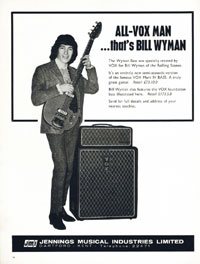
Bill Wyman was one of the earliest bass players to have his own signature model, with the Vox Wyman bass complementing the teardrop Mark III used by bandmate Brian Jones.
Basses with built-in electronic effects, but based on older JMI designs, such as the violin-shaped Astro (also favoured by Bill Wyman), the teardrop-shaped Constellation and the Phantom-shaped Delta joined simpler models such as the Panther and Hawk, with less unusual body styles.
The end of the decade, and the end of Vox?
As the 1960s drew to a close, Vox were in trouble. Guitar production ceased in the UK, and later Italy; the only new Vox guitars were of Japanese decent, but these were only available for a short period. The VG4 was the last bass produced for several years, whilst Vox limped on only producing amplifiers. Eventually some new Japanese Vox basses were produced a decade later, such as the Vox Standard and White Shadow; although these bore no relation to the models of the 1960s, and although reasonable instruments, are of less interest to vintage Vox collectors.
Latest Vox bass updates
The most recent content posted to this site on vintage Vox bass guitars:
 The Vox Bassmaster was first advertised in December 1960, and this was one of the very first examples dating from that year. With woodworking by furniture manufacturer Stuart Darkins and circuitry by Fenton Weill, it's quite different from later Bassmasters: natural nitrocellulose finish, bound body, slightly translucent pearloid 'VOX' scratchplate and single pickup. It is quite a nicely made guitar for its time, but lacks some of the adjustability that just a few years later would be seen as standard.
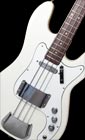 The Symphonic bass was built in the UK, by Vox parent company JMI. It was the Vox equivalent to the Fender Precision bass, and was one of the most expensive Vox guitars produced. It was actually a great playing bass, rather similar to the Precision in feel and sound, but was probably just too expensive compared to an actual Fender and consequently sold poorly. When Vox hit financial problems in 1968, unsold guitars and basses were passed on to Dallas Arbiter, who briefly sold the excess Symphonic bass stock as model 4537. This bass, although with a neck date of February 1966, was most likely one of the unsold Vox guitars sold on by Dallas Arbiter. Check out the bass, and the two video demos through 1960s Ampeg and WEM amplifiers.
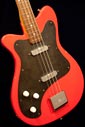 A nice example of the Vox Clubman II bass, built by JMI in Dartford, Kent in 1963. This is a lightweight bass, short (30") scale and very easy to play. It is an early example, and as such has a thin black scratchplate and side mounted, coaxial output jack. JMI offered left handed examples of their solid body Vox guitars and basses at 10% premium. Production numbers are unclear, but left-handed examples rarely come up for sale
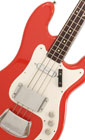 The Symphonic bass was one of the models produced by JMI in the UK, primarily for the early sixties British market. It was comparatively high priced, still cheaper in the UK than the Fender Precision that it was emulating, but not by much, and actually more expensive in the USA. It only sold in small numbers in Britain and barely at all overseas. No equivalent model was produced in Italy, and although it remained in UK price lists as late as 1967, it is unlikely many instruments were shipped beyond 1965.
 The Vox Bassmaster was one of numerous early Vox guitars styled, at least vaguely, on Fender instruments. As an entry level bass it wasn't bad. It had a very thin neck, and along with it's short, 30" scale, made an ideal students bass. It was British made, but a forerunner to later Italian models. Have a look at a 1963 Vox Bassmaster, and a 1965 Vox Bassmaster, with sound clips.
Guitars and Parts for Sale
Out Now

Need the value of your guitar? The Official Vintage Guitar Magazine Price Guide 2025 is out now: Amazon







![1968 Vox Stinger Bass Guitar Wiring Loom [159]](https://www.vintageguitarsforsale.co/uploads/257239359993/1968-Vox-Stinger-Bass-Guitar-Wiring-Loom-159-.jpg)