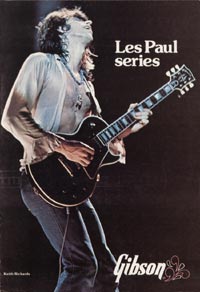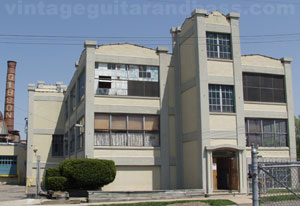
Vintage Gibson guitars are very special indeed, and they are held in very high regard by serious players and vintage guitar collectors alike. Especially the guitars made in the main Gibson plant, 225 Parsons Street, Kalamazoo, Michigan. The very best of these guitars were made in the 1950s and 1960s; often referred to as the CMI (Chicago Musical Instruments) period. These Gibsons are the epitome of quality. The best guitars were hand-built. Tops were carved and tap-tuned, a job requiring great skill and experience, and the pieces were assembled and finished by skilled craftsmen, with incredible attention to detail. But even the entry-level Gibson guitars were a step above the majority of guitars available at the time; both in terms of workmanship and components.
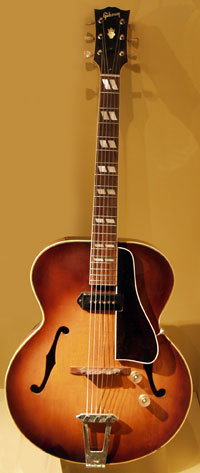
But this was a time of big change in the guitar market. Gibson specialised in expensive electric acoustics; high end jazz archtop models like the L5-CES, Super 400, ES-300, ES-350, ES-5, and the very well-known ES-175. These were all large hollow-body guitars with superb clean tones for jazz soloing. But 1955's Byrdland opened the door to a new possibility in guitar design, being the first thinline model.
Gibson endorsers of the 1950s were 'serious' musicians; often guitar virtuosos, in the jazz, pop or bluegrass genres. They would be accompanied by an upright bass, and a drummer using brushes. But the advent of rock 'n' roll changed everything. The necessary increase in volume rendered the jazz box almost obsolete and heralded the rise in popularity of the semi-acoustic and the solid-body.
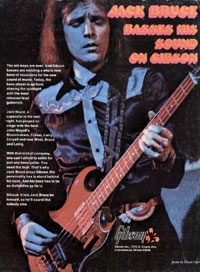
In this time, and under the stewardship of Ted McCarty, Gibson introduced the majority of the iconic models that it is famous for today. The Les Paul in 1952, the ES335, Flying V and Explorer in 1958, the Melody Maker in 1959, the SG in 1961, and the Firebird in 1963. Despite being superb instruments, many of these were too far ahead of their time, and were commercial failures until re-issued years later. Only 98 Flying V guitars were shipped between 1958 and 1959, and only 22 Explorers. The low-production numbers of these models guarantees their desirability to vintage guitar collectors, and if offered for sale could fetch a five or six figure sum, depending on the state of the market.
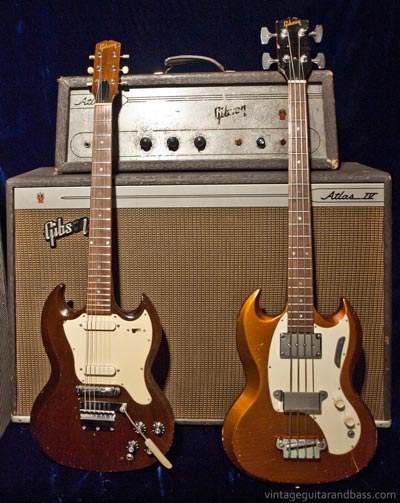
These classic guitars represent Gibson at their best. The quality of materials, workmanship and design placed Gibson guitars of this period right at the pinnacle of American guitar production. When people complain of perceived 'problems' with seventies, eighties or even current Gibson production, it is with these early sixties guitars that the comparison is being made. Gibson went from strength to strength in the early 1960s, selling guitars quicker than they had time to build them. 1965 was their peak year, selling over 83000 instruments. This success, however ultimately proved a huge problem for the company. They expanded to cover demand, even overproducing certain lines, only to find demand dropping in the later part of the decade. By the late 1960s, the American guitar industry was in trouble. Companies were folding and changing hands, and Gibson was no exception. Norlin took charge in December 1969, and immediately introduced numerous new models.
This period is not held in as high regard as the earlier CMI period, and it is true, Gibson produced a lot of low-priced guitars at this time, but the finest instruments are every bit as good as older versions. Guitars like the Citation, L-5S, and Crest are as good as anything Gibson ever built. In 1974 Gibson opened a new plant in Nashville, and some guitar output was moved there. The Nashville plant, especially early on, was unable to compete in terms of quality with Kalamazoo, and some of the seventies bad reputation may have been due to this.
This is the decade Gibson moved away from mahogany, in favour of other woods. The archetypal Gibson solid body sound was rich and dark; it had been produced by Gibson humbuckers, a mahogany body and a glued in mahogany neck. But there was a recognition that a wider tonal range would be greatly appreciated by the guitar buying public. In the early 1970s, electronics wizard Bill Lawrence designed a number of new guitars for Gibson: the L-6S, Marauder, S-1, Grabber bass and Ripper bass; all used maple and or alder, and many were natural-finished giving a distinctly different look to preceding models. They were electronically experimental, using a number of different techniques to achieve greater tonal palettes, from very simple ideas like a moveable pickup, to more in depth multi-position varitone switches.
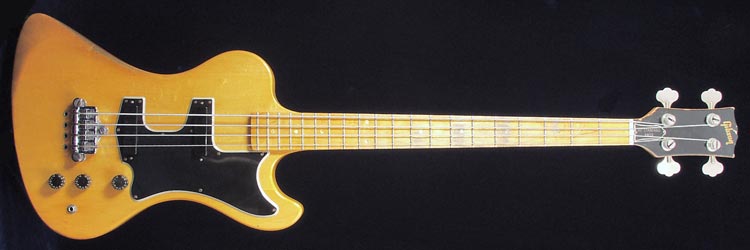
The two Gibson plants, Nashville and Kalamazoo, were running in tandem throughout the second half of the 1970s; Nashville built a large proportion of the solid body guitars, including Les Pauls, the L-6S, 335 solids etc, whilst Kalamazoo was the home of basses, hollow bodies, custom order instruments and new product development. A new 'Research and Development' team set to work, their first design taking the name of the group. The all-maple Gibson RD series was one of the last instruments to be made entirely at the Kalamazoo plant. But at this time, even necks on a lot of traditionally all-mahogany instruments went maple, for example 70s Les Pauls, SGs and solid-body 335S. The RD was a collaboration between Gibson and Moog (another norlin company); again an attempt to increase tonal range but this time by creating an active instrument with built-in Moog expansion and compression circuitry. The success of the RD Artist lead to other guitars being fitted with the same electronics, most notably the Les Paul Artist and ES-Artist.
The popularity of the electric guitar was declining somewhat in the early 1980s, but with two plants up and running, Gibson had no shortage of production capacity. So Gibson proceeded with the first of several attempts to create a line of products placed somewhere between it's Japanese built Epiphone 'copies' and it's regular Gibson guitars - see the article on non-Gibson Gibsons. The Gibson Sonex was a range of entry to intermediate level guitars produced at the Nashville plant, using an innovative wood/particle board (resonwood) composite body. The cheapest, the Sonex-180 Deluxe was built in the USA, but actually fitted with imported Japanese pickups and hardware, allowing for an incredibly low launch price. Other models in the series actually used standard Gibson hardware, and the Sonex Artist even had the Moog expansion/compression circuitry of the RD series.
The Gibson Victory series was again all maple with state-of-the-art electronics, this time by Tim Shaw, but still aimed at expanding the range of sounds available from a Gibson. They were passive, save the Artist bass, and even that had a switchable passive mode. These guitars were designed at Kalamazoo, and a few early examples were built there, before production of this line moved to Nashville, at the end of 1981.
Finally in 1984 the Kalamazoo plant closed, and all electric guitar production moved to Nashville. In January 1986 Gibson was sold to it's current owners.
Gibson was always rightly proud of it's beautifully-built American instruments, but such a large slice of the US guitar market was below the price point of a typical Gibson guitar. Whilst other distributors were importing cheaper guitars from around the world, Gibson attempted (several times) to produce more affordable instruments in the US - typically branded as something other than Gibson, but often with a nod towards the parent brand. These attempts were somewhat successful at first, (notably the 1930s and 1960s Kalamazoo brand) but unable to compete with the mass produced guitars of the 1970s and 1980s. Read more about Gibson's non-Gibson Gibsons: Kalamazoo, Epiphone, Epiphone USA Sonex and Gibson Guitar Co.
 The Gibson Victory MV-X, or Victory 'Multi-Voice' 10, was so-named because of the 10 distinct switch settings: although on first glance this guitar is very much a 'super-strat', with its three-pickup 5-way switch wiring configuration, the original advertising, sounds like... all of 'em underlines that this isn't just a Stratocaster copy, having the sounds of both Gibson humbuckers and Fender single coils available with a flick of a switch. The model was short-lived, with the first instruments shipping from Kalamazoo in Summer of 1981, and the last (excluding any stragglers) leaving Nashville by early 1982. This one, in Twilight Blue, was stamped on August 3rd 1981 in Kalamazoo.
 Scan of 1971 Selmer guitar catalogue showing the range of electric and acoustic guitars distributed by the company: guitars by Gibson, Yamaha, Selmer, Hofner and Suzuki. 1960s Selmer had always placed Hofner at the front end of their catalogues, no doubt these were the better sellers - but into the 1970s Hofner were slipping somewhat and only appear at the tail end of this publication, pride of place going to Gibson, and to a lesser extent Yamaha. In fact this is the last Selmer catalogue to include the many Hofner hollow bodies (Committee, President, Senator etc) that had defined the companies output for so many years - to be replaced in the 1972 catalogue by generic solid body 'copies' of Gibson and Fender models. A number of new Gibson models are included for the first time: the SG-100 and SG-200 six string guitars and the SB-300 and SB-400 basses.
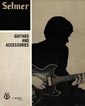 Scan of 1968/1969 Selmer guitar catalogue (printed July 1968), showing the entire range of electric and acoustic guitars distributed by the company: guitars by Hofner, Gibson, Selmer and Giannini. Selmer were the exclusive United Kingdom distributors of Hofner and Gibson at the time, and this catalogue contains a total of 18 electric guitars, 7 bass guitars, 37 acoustics, and 2 Hawaiian guitars - all produced outside the UK and imported by Selmer, with UK prices included in guineas. This catalogue saw the (re-)introduction of the late sixties Gibson Les Paul Custom and Les Paul Standard (see page 69) and the short-lived Hofner Club 70. Other electric models include: HOFNER ELECTRICS: Committee, Verithin 66, Ambassador, President, Senator, Galaxie, HOFNER BASSES: Violin bass, Verithin bass, Senator bass, Professional bass GIBSON ELECTRICS: Barney Kessel, ES-330TD, ES-335TD, ES-345TD, ES-175D, ES-125CD, SG Standard, SG Junior, SG Special GIBSON BASSES: EB-0, EB-2, EB-3 - plus a LOT of acoustics branded Gibson, Hofner, Selmer and Giannini
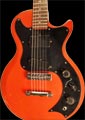 Production of Bill Lawrence's Gibson Marauder began in 1974, with production peaking in 1978. But by 1980 the model was officially discontinued, though very small numbers slipped out as late as spring 1981. Over 7000 examples shipped between 1974 and 1979, and although no totals are available for 1980 and 1981, it is unlikely production reached three figures in either of these years. These final Marauders were all assembled at the Gibson Nashville plant, and had some nice features not available through the later years of production, such as a rosewood fretboard, and in this case, an opaque 'Devil Red' finish. It's a great looking and fine playing guitar!
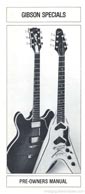 'Gibson Specials' was part of the June 1981 pre-owners manual series, but unlike the other folders contained a mish-mash of different guitars: limited editions, test marketing and close outs. "You will find the unusual, the brand-new, and the bargain within this folder". End of line 70s guitars like the Marauder, S-1, and L-6S Custom mixed in with brand new models the The V, The Explorer and the Flying V Bass.
Need the value of your guitar? The Official Vintage Guitar Magazine Price Guide 2025 is out now: Amazon

$325000

$300000

$125000
$98000
$98000
$96395
$92195

$89999

$85900
$85000

$81900

$78000
$74995

$61900

$54900

$50000
$38900

$37995
$37799

$36000

$35900

$34995

$34900
$33500
$32999

$32500

$32000

$32000

$30499

$29995
Follow


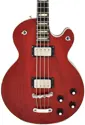 The Hagstrom Swede bass, or model HB 903, was only built in small numbers: just 1479 basses shipped between 1971 and 1976. Unlike the current range of Hagstrom guitars, the 1950s-1980s Hagstroms were built in Sweden. This example comes from 1973 and is pretty typical: translucent cherry finish, mahogany body, mahogany neck with an ebony fretboard. It's a really nice bass, beautifully appointed with a very wide tonal range, and a great playing feel. It is relatively heavy though for a mahogany instrument, mostly due to its thick solid body. Very cool bass, and certainly one of the very best basses produced by Hagstrom.
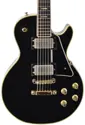 This example of the Shaftesbury 3400 was produced by Japanese manufacturer Matsumoku who made some great quality guitars in the 1970s and 1980s. This is a slightly later example, and has some features not seen on earlier 3400s. Although nice guitars, these are not in the same league as the Gibson Les Paul it was emulating (no set neck, no carved maple top); but they are far better than many of the entry-level Les Paul copies available in the mid-1970s - for example the Shaftesbury 3400 has gold plated hardware, a solid body bound front and back, Maxon brand humbuckers and nice inlaid neck and headstock.
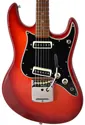 The Epiphone 1802T was the early name given to the Epiphone ET-270 and derived from an existing Aria guitar, also the 1802T. This was the first of the 1970s Epiphone solid bodies made in Japan by Matsumoku.The model evolved somewhat over its short production run: the very earliest examples were very similar to the Aria, sharing the same body shape, hardware, and clear-coated neck with Fender-style headstock with decal logo. By the time it was designated the Epiphone ET-270 it had been upgraded with the classic Epiphone-style headstock, with nice inlaid logo, and Epiphone 'E' motifs on the truss rod cover and scratchplate. This example from 1971 is somewhere in between with the Epiphone-style headstock, but with silk-screened logo, and no 'E's.
 Shaftesbury was a brand distributed by Rose-Morris in the UK - generally imported guitars from Italy or Japan. This guitar, model 3400 was produced by Matsumoku in Japan, and was one of the earliest Les Paul copy guitars, debuting in the UK in 1969, although the same guitar was also sold as the Univox U1982 'Rhythm and Blues' by Merson in the USA as early as 1968. It was also available in different territories under different marques, most obviously the Aria 5522 (Japan), Jedson Jet 4444 (UK, Dallas Arbiter), with no doubt many more examples worldwide.The Gibson Victory MV-X, or Victory 'Multi-Voice' 10, was so-named because of the 10 distinct switch settings: although on first glance this guitar is very much a 'super-strat', with its three-pickup 5-way switch wiring configuration, the original advertising, sounds like... all of 'em underlines that this isn't just a Stratocaster copy, having the sounds of both Gibson humbuckers and Fender single coils available with a flick of a switch. The model was short-lived, with the first instruments shipping from Kalamazoo in Summer of 1981, and the last (excluding any stragglers) leaving Nashville by early 1982. This one was stamped on August 3rd 1981 in Kalamazoo.
 Scan of 1970 Epiphone guitar catalogue produced by Rosetti for the UK market. Undated but most likely from mid-late 1970, this was the first UK catalogue to show the new range of Japanese (Matsumoku) Epiphone guitars. Interestingly, these pages show the Epiphone solid bodies with a single-sided Fender-style headstock layout - a feature quickly replaced with a typical two-sided Epiphone headstock almost immediately. Epiphone electric guitars: 9520, 9525; bass guitars: 9521, 9526; acoustic guitars: 6730, 6830, 6834
 Scan of 1971 Rosetti catalogue (UK) featuring guitars from from numerous manufacturers worldwide: guitars by Epiphone, Hagstrom, Levin, Hoyer, Egmond, Eros, Moridaira, Kiso-Suzuki, Schaller, and Tatra.Scan of 1971 Selmer guitar catalogue showing the range of electric and acoustic guitars distributed by the company: guitars by Gibson, Yamaha, Selmer, Hofner and Suzuki. 1960s Selmer had always placed Hofner at the front end of their catalogues, no doubt these were the better sellers - but into the 1970s Hofner were slipping somewhat and only appear at the tail end of this publication, pride of place going to Gibson, and to a lesser extent Yamaha. In fact this is the last Selmer catalogue to include the many Hofner hollow bodies (Committee, President, Senator etc) that had defined the companies output for so many years - to be replaced in the 1972 catalogue by generic solid body 'copies' of Gibson and Fender models. A number of new Gibson models are included for the first time: the SG-100 and SG-200 six string guitars and the SB-300 and SB-400 basses.Scan of 1968/1969 Selmer guitar catalogue (printed July 1968), showing the entire range of electric and acoustic guitars distributed by the company: guitars by Hofner, Gibson, Selmer and Giannini. Selmer were the exclusive United Kingdom distributors of Hofner and Gibson at the time, and this catalogue contains a total of 18 electric guitars, 7 bass guitars, 37 acoustics, and 2 Hawaiian guitars - all produced outside the UK and imported by Selmer, with UK prices included in guineas. This catalogue saw the (re-)introduction of the late sixties Gibson Les Paul Custom and Les Paul Standard (see page 69) and the short-lived Hofner Club 70. Other electric models include: HOFNER ELECTRICS: Committee, Verithin 66, Ambassador, President, Senator, Galaxie, HOFNER BASSES: Violin bass, Verithin bass, Senator bass, Professional bass GIBSON ELECTRICS: Barney Kessel, ES-330TD, ES-335TD, ES-345TD, ES-175D, ES-125CD, SG Standard, SG Junior, SG Special GIBSON BASSES: EB-0, EB-2, EB-3 - plus a LOT of acoustics branded Gibson, Hofner, Selmer and Giannini
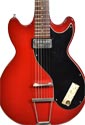 Hofner Colorama was the name UK distributor Selmer gave to a series of solid and semi-solid guitars built by Hofner for distribution in the UK. The construction and specifications of the guitars varied over the period of production, but by 1961 it was a totally solid, double cutaway instrument, with a set neck, translucent cherry finish, six-in-a-row headstock, and Hofner Diamond logo pickups. Available as a single or dual pickup guitar, this sngle pickup version would have been sold in mainland Europe as the Hofner 161.
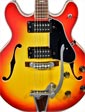 Commodore was a brand applied to a series of guitars produced in Japan at the well-respected Matsumoku plant from the late 1960s to the mid 1970s - and sold primarily (perhaps exclusively?) in the United Kingdom. The models bearing the Commodore name were all guitars available from different distributors with different branding. Although there may have been some minor changes in appointments (specifically headstock branding) most had the same basic bodies, hardware and construction. Equivalent models to the Commodore N25 (and this is by no means an exhaustive list) include the Aria 5102T, Conrad 5102T(?), Electra 2221, Lyle 5102T, Ventura V-1001, Univox Coily - and most famously the Epiphone 5102T / Epiphone EA-250.
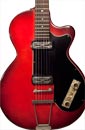 The Hofner Colorama was the name given by Selmer to a series of solid (and semi-solid) body Hofner guitars distributed in the United Kingdom between 1958 and 1965. The Colorama name actually applied to some quite different guitars over the period, but in 1960 it was a very light, semi-solid, set necked guitar with one (Colorama I) or two (Colorama II, as seen here) Toaster pickups. Although an entry-level guitar, it was very well-built, and a fine playing guitar; certainly a step up (at least in terms of craftsmanship) from many of the Colorama guitars that would follow, and a good deal of the guitars available in Britain circa 1960.
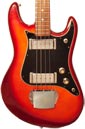 By the end of the 1960s, a decision had been made to move Epiphone guitar production from the USA (at the Kalamazoo plant where Gibson guitars were made), to Matsumoto in Japan, creating a line of guitars and basses significantly less expensive than the USA-built models (actually less than half the price). The Matsumoku factory had been producing guitars for export for some time, but the 1820 bass (alongside a number of guitar models and the 5120 electric acoustic bass) were the first Epiphone models to be made there. These new Epiphones were based on existing Matsumoku guitars, sharing body shapes, and hardware, but the Epiphone line was somewhat upgraded, with inlaid logos and a 2x2 peghead configuration. Over the course of the 70s, the Japanese output improved dramatically, and in many ways these early 70s models are a low point for the brand. Having said this, there are a lot worse guitars out there, and as well as being historically important, the 1820 bass can certainly provide the goods when required.Production of Bill Lawrence's Gibson Marauder began in 1974, with production peaking in 1978. But by 1980 the model was officially discontinued, though very small numbers slipped out as late as spring 1981. Over 7000 examples shipped between 1974 and 1979, and although no totals are available for 1980 and 1981, it is unlikely production reached three figures in either of these years. These final Marauders were all assembled at the Gibson Nashville plant, and had some nice features not available through the later years of production, such as a rosewood fretboard, and in this case, an opaque 'Devil Red' finish. It's a great looking and fine playing guitar!
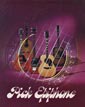 When Epiphone production moved from Kalamazoo to the Matsumoku plant in Japan, a whole new range of electric, flattop and classic acoustic guitars was launched. Between late 1970 and 1972 the new models were launched and refined. This 'folder' catalog contains various inserts released over these years detailing four electric six-strings (ET-270, ET-275, ET-278, and thinline EA-250), three bass guitars (ET-280, ET-285, and thinline EA-260), three folk/steel acoustics, four jumbo flattop acoustics, two 12-string jumbos, four classic acoustics, and a banjo.'Gibson Specials' was part of the June 1981 pre-owners manual series, but unlike the other folders contained a mish-mash of different guitars: limited editions, test marketing and close outs. "You will find the unusual, the brand-new, and the bargain within this folder". End of line 70s guitars like the Marauder, S-1, and L-6S Custom mixed in with brand new models the The V, The Explorer and the Flying V Bass.
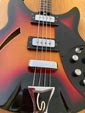 Rose-Morris were selling Shaftesbury-branded Rickenbacker copy instruments from the late 1960s right through the 1970s. The 3263 bass was one of the first models, (alongside the 3261 six string and 3262 twelve string) available from late 1968 until about 1974. The earliest incarnation was a set neck bass, produced very briefly in Japan. But production quickly moved to Italy. This bolt-on neck example was built by Eko, in Recanati, using the same hardware and pickups as fitted to Eko, and Vox basses built around the same time. It's certainly a fine looking bass, and not a bad player either.
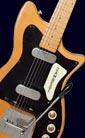 This very early, and pretty rare British-built guitar is branded Hohner London. Hohner were, of course, a German company, better known for their harmonicas and accordions, but they were keenly expanding into guitars at the birth of the 1960s. This model, along with the Hohner Amazon and (particularly) the Hohner Holborn, bear some similarity with Vox guitars of the same period; furniture manufacturer Stuart Darkins constructed bodies and necks for both brands, with Fenton Weill assembling them using their hardware and pickups. These guitars do have some hardware peculiarities, and they are not the most adjustable of instruments, but they actually play very nicely, being solidly built out of some very nice woods. Check out the video on this page.
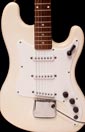 The Vox Super Ace was a mid-priced British solid body electric guitar, produced by JMI at their factory in Dartford, Kent. It was broadly modelled on the Fender Stratocaster, and a sibling model to the dual-pickup Vox Ace. Both the Ace, and Super Ace (along with several other models), were redesigned in 1963 with a new body shape, headstock style, and pickup layout - only increasing the resemblance to the aforementioned Fender. The Super Ace had a 1963 price tag of £47 5S. It's a pretty nice playing guitar with some lovely sounds - check out the videos on this page, and in the Vintage Guitar and Bass supporting members area
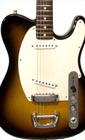 The Vox New Escort was Vox's version of the Fender Telecaster, at a time when American guitars were out of reach for most British musicians. It was made by JMI in England, for the British market, and unlike the majority of other models, didn't have an Italian-made equivalent. But the New Escort wasn't a slavish Fender copy, adding Vox's stylish teardrop headstock to the tele-style body, with a stop tailpiece and two Vox V2 single coil pickups. And it's a pretty substantial, and nice playing guitar, with a very comfortable neck. Check out the images, specifications, and watch a video of it in action. There is also extra content in the vintageguitarandbass supporting members area.
 Catalog scan. The 1969 Fender Lovin' Care catalog consisted of 48 pages of electric guitars, basses, amplifiers, steel guitars, acoustic guitars, banjos and keyboards. Like the previous catalog, this featured the company's guitars in a variety of interesting settings around California, from the Whiskey-A-Go-Go, to the Hollywood Bowl. Several instruments were making their first appearance amongst it's pages: the Telecaster bass, Montego and LTD jazz guitars, and the Redondo acoustic. It was the final catalog appearance, however, of the Electric XII, Bass V, Duo-Sonic, Coronado I and Coronado Bass I.
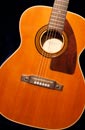 The Eko Ranger series of guitars was incredibly popular in the second half of the 1960s and through the 1970s, selling in very large numbers. The Ranger Folk was 1 1/4" smaller, and 1" shallower than the Ranger VI and XII - and with a narrower waist. Not a bad guitar; a little quiet, but pretty playable. These were great value in 1973, and because they sold so many, they are easy to find and excellent value today.
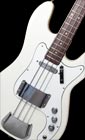 The Symphonic bass was built in the UK, by Vox parent company JMI. It was the Vox equivalent to the Fender Precision bass, and was one of the most expensive Vox guitars produced. It was actually a great playing bass, rather similar to the Precision in feel and sound, but was probably just too expensive compared to an actual Fender and consequently sold poorly. When Vox hit financial problems in 1968, unsold guitars and basses were passed on to Dallas Arbiter, who briefly sold the excess Symphonic bass stock as model 4537. This bass, although with a neck date of February 1966, was most likely one of the unsold Vox guitars sold on by Dallas Arbiter. Check out the bass, and the two video demos through 1960s Ampeg and WEM amplifiers.
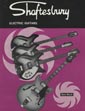 The 1968 Shaftesbury 'Electric Guitars' catalog was just four pages long, and contained four guitar models: the six string Barney Kessel-style 3264; and three Rickenbacker-styled semi-acoustic models: the six-string 3261, the twelve string 3262 and the 3263 bass. Shaftesbury was the house-brand of major UK distributor Rose-Morris, and seems to have been launched as a response to the company's loss of it's distribution deal with Rickenbacker. The guitars were mid-priced, and built in (initially) Japan, and later Italy, by Eko
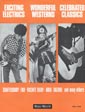 1970 Rose-Morris catalog, dated April 1970. It featured 6 electric guitars, 32 acoustic guitars, 3 basses and 1 steel guitar. It contains the following instruments, over 20 pages: Electric guitars: Shaftesbury 3261, 3262, 3264, 3265, 3400; Top Twenty 1970; Bass: Shaftesbury 3263, 3266; Top Twenty 1971; Acoustic guitars: Eko Rio Bravo, Rio Bravo 12, Ranchero, Ranchero 12, Colorado, Ranger, Ranger Folk, Ranger 12; Aria 1674, 1675, 1676, 1679, 1680, 1695, 'John Pearse' Jumbo, 'John Pearse' Folk; Rose-Morris 15-11, Kansas, Georgian, Florida; Suzuki 1663, 1664, 1665, 3054, 3055, 3060; Tatay 1713, 1714, 1715; Peerless 3052; Steel guitar: Aria 3425
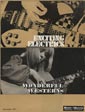 The sixteen-page 1971 Rose-Morris catalog featured electric guitars by Rose-Morris' own brand, Shaftesbury, and budget brand Top Twenty; aswell as acoustics by Eko, Aria, and for the first time Ovation. The catalog contains the following instruments: Electric guitars: Shaftesbury 3261, 3264, 3265, 3400, 3402; Top Twenty 1970; Bass: Shaftesbury 3263, 3266; Top Twenty 1971; Acoustic guitars: Ovation: Balladeer, 12 String, Glen Campbell, Glen Campbell 12 string; Eko Rio Bravo, Rio Bravo 12, Ranger, Ranger Folk, Ranger 12, Colorado, Ranchero, Ranchero 12, Studio 'L'; Rose-Morris Florida; Aria 'John Pearse' Jumbo, 'John Pearse' Folk
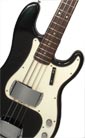 A detailed look at an early 1970s Fender Precision bass guitar in custom black finish, with rosewood fretboard. 1972 list price, $307.50. The Fender Precision had been shipping since at least very early 1952 - with just one re-design circa 1957. This example, then, shows a model already two decades old, but barely changed since the '57 revamp. Fender got it right first time around, and although there are numerous minor cosmetic differences, the essence of this bass is effectively the same as it was in '52: a simple, single pickup instrument with a GREAT sound. Check out the demo video through an old Ampeg B15. It's no wonder this is the bass that everybody wants!
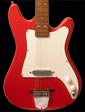 The Vox Stroller was the brand's entry level electric solid body guitar, fitted with just one pickup and a fixed tailpiece. Although aimed at student guitarists, it wasn't a terrible instrument, but did lack somewhat in adjustability, having no accessible truss rod and only a floating rosewood bridge. But this example is actually quite an improvement on earlier versions, with a standard 1/4" jack and a solid mahogany body. 1967 price £18 2s. JMI ceased UK guitar production in late '67, and combined with decreasing demand for the Stroller, this surely must be one of the last examples shipped.
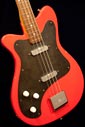 A nice example of the Vox Clubman II bass, built by JMI in Dartford, Kent in 1963. This is a lightweight bass, short (30") scale and very easy to play. It is an early example, and as such has a thin black scratchplate and side mounted, coaxial output jack. JMI offered left handed examples of their solid body Vox guitars and basses at 10% premium. Production numbers are unclear, but left-handed examples rarely come up for sale
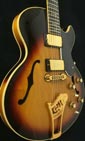 Not to be confused with the Gibson ES Artist launched by Gibson in 1979; this ES Artist was an early model designed by the Gibson research and development team in Kalamazoo in 1977, the instruments themselves constructed by Gibson artist Chuck Burge. It was planned for launch as a high end semi acoustic with 335-style construction (central maple block) and innovative circuitry - but was pulled at the last minute, being deemed too expensive. Apparently, several examples were produced with varying specifications, though exactly how many actually left the Kalamazoo plant is unclear. Certainly two guitars were sold to LaVonne Music by Gibson in around 1980. Read more about the development of this guitar, with details from Chuck Burge and the story of it's sale to LaVonne music