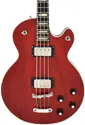
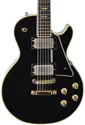
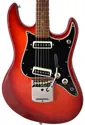
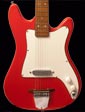
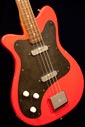
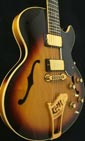
1981 guitar, bass and amp advertising







1981 guitar catalogues
1981 Gibson guitar and bass catalog - published by Rosetti for the UK
1981 Gibson Sonex Catalog
1981 Gibson Specials Pre-Owners Manual
1981 Gibson Victory Bass Catalog
1981 Gibson Victory Bass Owners Manual
1981 Gibson Victory Guitar Catalog
1981 Gibson Victory MV Owners Manual
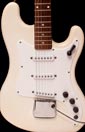
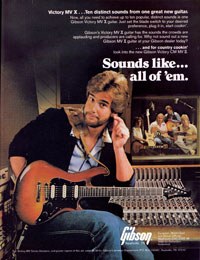
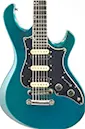 The Gibson Victory MV-X, or Victory 'Multi-Voice' 10, was so-named because of the 10 distinct switch settings: although on first glance this guitar is very much a 'super-strat', with its three-pickup five-way switch wiring configuration, the original advertising, sounds like... all of 'em underlines that this isn't just a Stratocaster copy, having the sounds of both Gibson humbuckers and Fender single coils available with a flick of a switch. The model was short-lived, with the first instruments shipping from Kalamazoo in Summer of 1981, and the last (excluding any stragglers) leaving Nashville by early 1982. This one, in Twilight Blue, was stamped on August 3rd 1981 in Kalamazoo.
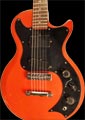 Production of Bill Lawrence's Gibson Marauder began in 1974, with production peaking in 1978. But by 1980 the model was officially discontinued, though very small numbers slipped out as late as spring 1981. Over 7000 examples shipped between 1974 and 1979, and although no totals are available for 1980 and 1981, it is unlikely production reached three figures in either of these years. These final Marauders were all assembled at the Gibson Nashville plant, and had some nice features not available through the later years of production, such as a rosewood fretboard, and in this case, an opaque 'Devil Red' finish. It's a great looking and fine playing guitar!
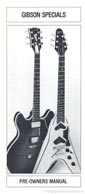 'Gibson Specials' was part of the June 1981 pre-owners manual series, but unlike the other folders contained a mish-mash of different guitars: limited editions, test marketing and close outs. "You will find the unusual, the brand-new, and the bargain within this folder". End of line 70s guitars like the Marauder, S-1, and L-6S Custom mixed in with brand new models the The V, The Explorer and the Flying V Bass.
It was the largest folder in the series, with 24 inserts, (19 guitars and 5 basses): Guitars: 335-S Standard, Melody Maker Double, Marauder, L-6S Custom, S-1, RD Artist, Firebird, Firebird II, Flying V, Flying V-II, The V, Explorer, Explorer II, The Explorer, The "SG" Standard, Les Paul Artist, Les Paul Artisan, ES-335 Heritage, ES-175/CC Basses: Grabber, G-3, L-9S, RD Artist Bass, Flying V Bass
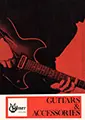
 20 pages, black and white with color front cover. In the middle of 1981, Rosetti took over distribution of the Gibson line in the UK. Rosetti were a very big name in Britain, having distributed Epiphone since at least 1963, as well as Hagstrom and others. This catalogue was produced at the tail end of 1981, and introduces a number of models to the UK, such as the MV-II, MV-X guitars and the Victory basses, the GGC-700 and the Flying V bass. Some of these models were so short-lived that they were actually never included in US brochures. The cover image (reproduced in part here) showed some of the earliest demonstration models, including a Victory with a highly unusual white scratchplate.
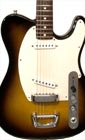
 A closer look at a 1981 Gibson Victory MV-II electric guitar. The Gibson Victory MV, or 'Multi-Voice' guitars had very wide tonal palettes; with coil-tapped humbuckers they could produce typical Gibson tones, but were also designed to 'out-Fender' Fender. Two models were launched in the summer of 1981. Whilst the MVX, was designed to do everything a Stratocaster could do, the MVII was 'primarily for the discerning country player' - placing it squarely against the Telecaster.
Got an opinion on the contents of this page? Disagree with something written above? Please comment