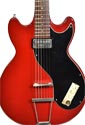
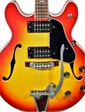
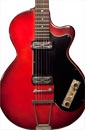
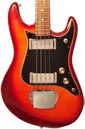
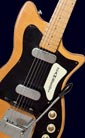
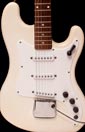
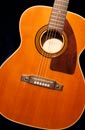
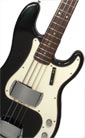
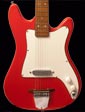
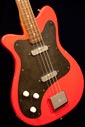
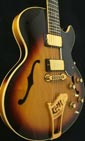
1966 guitar, bass and amp advertising


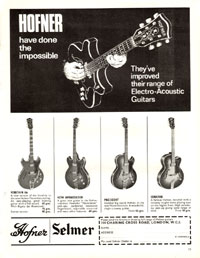


1966 guitar catalogues
1965/66 Selmer Guitars and Accessories Catalog
1966-67 Fender guitar and bass catalog
1966 Epiphone 'Guitars, Basses, Amplifiers' Catalog
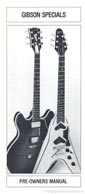
1966 Gibson 'Feel the excitement?' Flyer
1966 Gibson 'Guitars & Amplifiers' Catalog
1966 Goya Electric Guitar and Bass Catalog
1966 Hagstrom guitar Catalog
1966 Hagstrom guitars and basses "with the world's fastest playing neck" catalog
1966 Kalamazoo catalog - Guitars Amplifiers
1966 Supro Electric Guitar, Bass and Amplifier Catalog
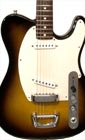 The Vox New Escort was Vox's version of the Fender Telecaster, at a time when American guitars were out of reach for most British musicians. It was made by JMI in England, for the British market, and unlike the majority of other models, didn't have an Italian-made equivalent. But the New Escort wasn't a slavish Fender copy, adding Vox's stylish teardrop headstock to the tele-style body, with a stop tailpiece and two Vox V2 single coil pickups. And it's a pretty substantial, and nice playing guitar, with a very comfortable neck. Check out the images, specifications, and watch a video of it in action. There is also extra content in the vintageguitarandbass supporting members area.
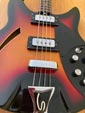
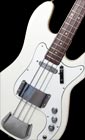 The Symphonic bass was built in the UK, by Vox parent company JMI. It was the Vox equivalent to the Fender Precision bass, and was one of the most expensive Vox guitars produced. It was actually a great playing bass, rather similar to the Precision in feel and sound, but was probably just too expensive compared to an actual Fender and consequently sold poorly. When Vox hit financial problems in 1968, unsold guitars and basses were passed on to Dallas Arbiter, who briefly sold the excess Symphonic bass stock as model 4537. This bass, although with a neck date of February 1966, was most likely one of the unsold Vox guitars sold on by Dallas Arbiter. Check out the bass, and the two video demos through 1960s Ampeg and WEM amplifiers.
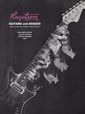 Hagstrom guitars were distributed in the mid-1960s United States by Merson of USA. This eight page 'worlds fastest playing neck' catalog, printed in two-colors contained six solid body electrics, three solid body basses, two electric acoustic guitars, two electric acoustic basses and five acoustics.
 The 1965/1966 Selmer guitar catalogue contained guitars by a number of different makers imported for the UK market, the most numerous being German-made Hofner electrics, acoustics and basses. There is also a fairly large Gibson section, but it by no means contains all instruments produced under that brand at the time. Other instruments featured include guitars and basses by Hagstrom and Futurama, and Brazilian acoustic guitars by Giannini. 44 pages, with UK pricing in guineas.
 Goya was well-known for it's acoustic guitars, produced by Levin in Sweden; but in the mid 1960s they added a number of Italian-built electric guitars and basses. Semi-acoustic models such as the 105, 107 and 109 Rangemaster guitars and Panther II bass were made by Polverini, whilst solid body models 116 and 118 were made by Galanti. These were well-built good quality instruments, but perhaps too expensive to sell in large numbers.
 Gibson assembled these 30 1/2' scale Kalamazoo KB-1 basses in their electronics plant in Kalamazoo, MI - separate from the main Gibson plant. They used the same components and hardware as on the Gibson EB bass series; but with a pre-painted masonite body and a bolt-on maple neck; a very different construction to Gibson's usual output. Initially the KB bass had a Mustang-shaped body (see the 1966 Kalamazoo KB-1, left), which was soon redesigned with the classic SG shape (see the 1967 Kalamazoo KB-1, right). Have a listen to sound clips of this bass here.
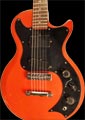
 Details and information on the Kalamazoo KG2a electric guitar. The beat boom of the mid 1960s heralded a huge demand for electric guitars; youngsters up and down America were looking for affordable, well-built solid-bodies, with modern looks and a great sound. Gibson, better known for it's high-end jazz guitars, responded by producing the KG guitar and KB bass lines, under the Kalamazoo brand. They were initially modelled on the Fender Mustang, though soon took the shape of the Gibson SG, which was rapidly rising in popularity. The resulting instruments used modern composite wood technology, Fender style construction and actual Gibson hardware. They looked good, played well, and sold in large quantities. See also Kalamazoo KG shipping figures, a 1966 Kalamazoo KG1 (single pickup) and listen to the Kalamazoo KG soundclips.
 The Hagstrom Coronado is one of the most distinctive bass guitars ever manufactured; the quirky controls, 32" scale, and unique shape. The body and neck are mahogany, but with bolt on construction. This 1966 Coronado is one of the later guitars, so does not have the Hagstrom Bi-Sonic pickups, but it is still a great sounding, and highly playable bass. Check out the short Hagstrom Coronado bass sound clips on this site.
 The 1966 Supro guitar, bass and amplifier catalogue ran to just 8 pages, and featured featured the Supro Arlington, Supro Lexington and Supro Normandy solid body ranges, the Supro Stratford, Supro Carlisle, Supro Clermont, Supro Croydon thin lines, and two basses, the Supro Pocket bass and the Supro Taurus bass. There were also 14 different Supro amplifiers.
 Images and description of a 1966 Gibson ES-175D. Gibson's full-body jazz guitars are widely regarded, and the ES-175D is still the standard to which other manufacturers aspire. The ES-175 available today, has changed very little from the instruments of 40 years ago.
 A closer look at a 1966 Epiphone Granada. The non-cutaway Granada was the Epiphone version of the Gibson E120T thinline hollowbody. Both were built side by side in Gibson's Kalamazoo plant, and were the least expensive hollowbodies in their respective ranges. Sales of the Epiphone version were never huge (see Epiphone Granada shipping figures, at least compared to the Gibson, even when an otherwise identical cutaway model, the E444TC, was added. No Gibson cutaway version was released.
Got an opinion on the contents of this page? Disagree with something written above? Please comment